By Rodrigo Custodio, December 2024

Brazil’s auto industry is again at one of its crossroads. The moment reminds many of 2013, when the country was aiming at 5 million vehicle sales and production, celebrated Inovar-Auto, and saw an influx of FDI. This was then followed by the country’s fiscal policy misarrangements, leading to a sudden trend reversal.
2024 is still far from the 5 million vehicles target once dreamt of; nonetheless, sales show a consistent ramp-up for the 4th consecutive year. Brazil is amongst the leading growth markets projected for 2025. We celebrate MOVER and welcome new players, some of which will operate legacy plants of those who abandoned the market.
Our investigation (conducted from June-September/24) suggests that the market is performing well despite macroeconomic challenges and that there’s a different growth engine, with a new competitive set-up being drawn for 2025.
Whether macroeconomics will help its development in 2025 remains to be seen, but as the industry continues its way towards 3 million units, the entire value chain needs to adapt to a new game.
Our report highlights some of the conclusions. We hope that you enjoy your reading!
How Brazil’s auto industry got here
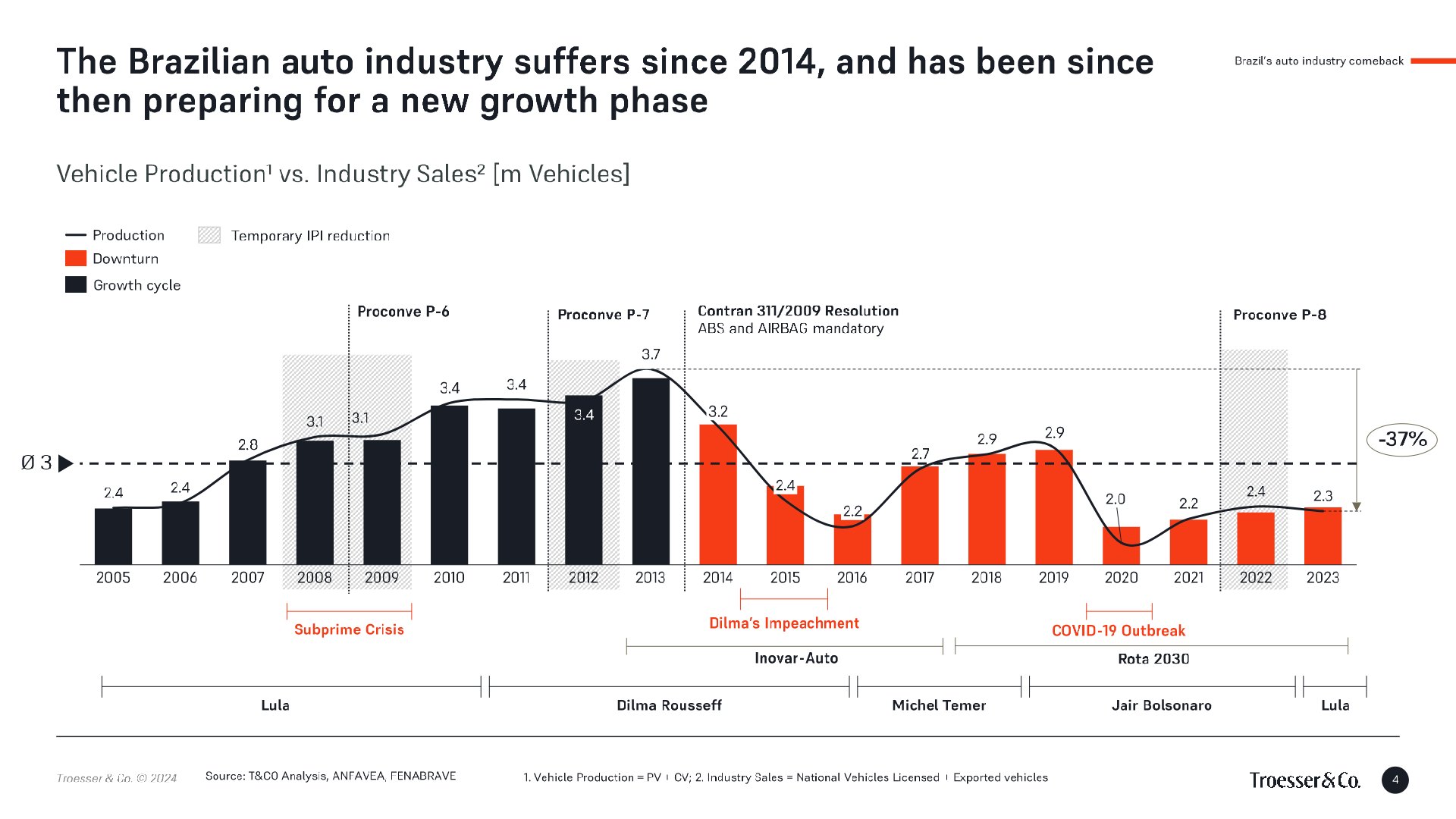
Brazil’s auto industry reached its peak in 2013, with 3.7 million vehicles produced, after a growth phase built on apparently sound economics and public incentives. From 2014 the market changed, and by 2023 production stood at 2.3 million units, 37% below the peak. The industry depends largely on the domestic and Argentinian markets and felt the swings of both economies directly. In 2019, as volumes were recovering, the COVID-19 outbreak interrupted the path again.
The Brazilian automotive industry answered with restructuring. Between 2010 and 2019, the debt-like intercompany position of foreign automotive investment rose from USD 1.1bn to USD 11.5bn as parent companies financed their local operations. Companies lowered their breakeven points, reduced overheads, adjusted capacities and revised their positioning, and several found their way back to profit. By 2022 the intercompany position had come down to USD 6.2bn, while the equity-like capital stock had risen to USD 25.8bn. The industry that emerged has fewer players, more focused competitors and a sharper cost base.
An aging car parc keeps demand high
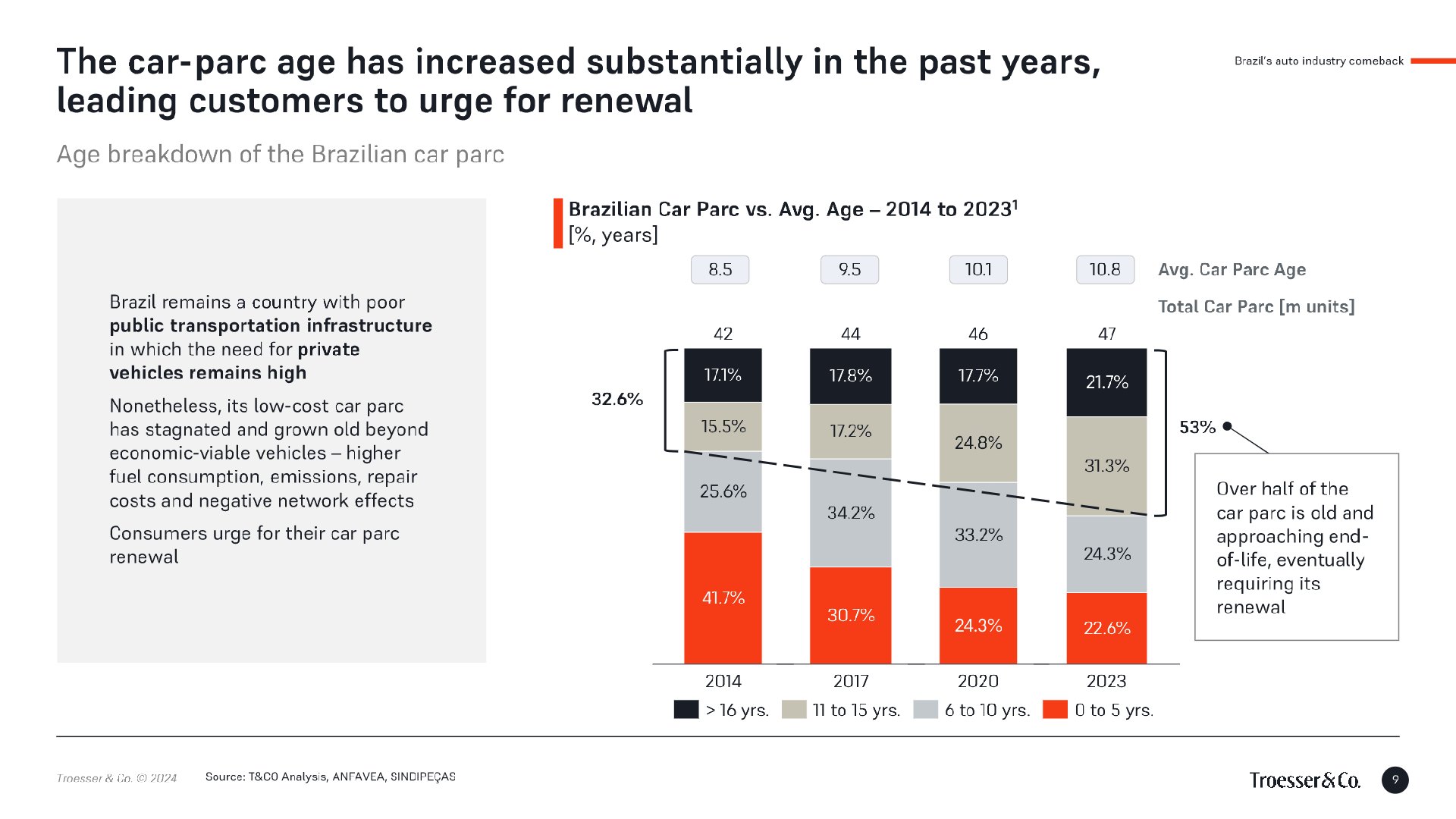
Public transport infrastructure in Brazil remains limited, so the need for private vehicles is high. At the same time, the car parc has aged. Between 2014 and 2023 it grew from 42 to 47 million vehicles, and the average age rose from 8.5 to 10.8 years. Vehicles older than 10 years now account for 53% of the parc, up from 32.6% in 2014. Older vehicles mean higher fuel consumption, emissions and repair costs, and a growing share of the parc is approaching the end of its useful life.
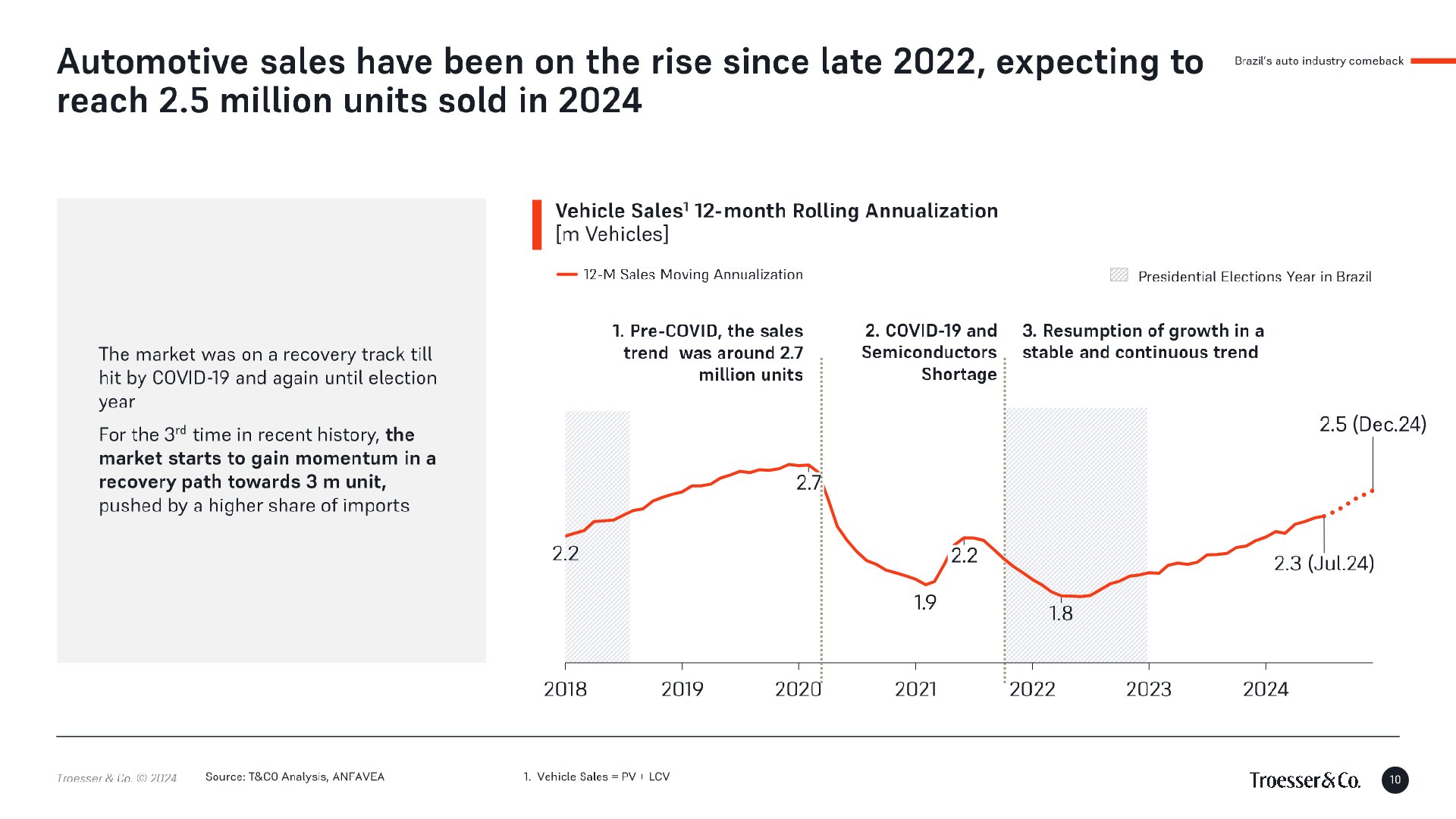
Sales reflect this demand. After a low of 1.8 million units in 2022, measured on a 12-month rolling basis, vehicle sales have risen steadily, reaching 2.3 million units in the 12 months to July 2024, with 2.5 million expected for the full year. For the third time in recent history, the market is on a path toward 3 million units.
Imports and Chinese OEMs capture much of the growth
Local production has not kept pace with sales. Historically, Brazil produced more vehicles than it sold domestically, with the difference going to exports. In 2024 this reversed: annualized sales reached 2.3 million units against 2.2 million produced, and the additional demand is being met mostly by imports. Exports, meanwhile, have become harder to place, with weaker economic activity in Latin America and a changing global market.
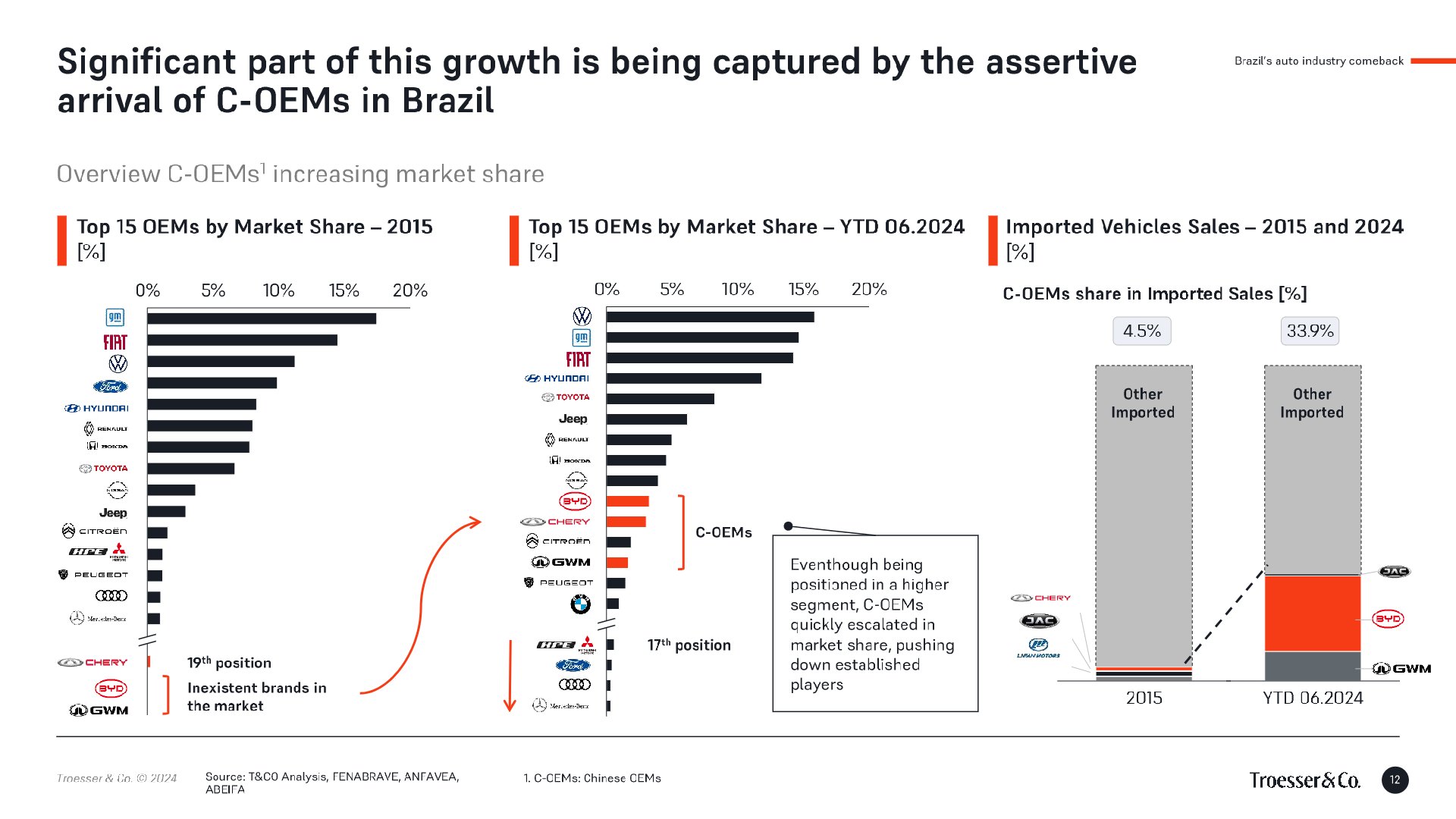
A large part of these imports comes from Chinese OEMs. Their share of imported vehicle sales in Brazil rose from 4.5% in 2015 to 33.9% in the first half of 2024. In 2015, BYD and GWM had no presence in the market. By mid-2024, Chinese brands had entered the top 15 OEMs by market share, despite being positioned in higher segments, and established players had lost ground.
By August 2024, more than 10 Chinese players had announced plans to enter Brazil, and some intend to produce locally. BYD expects full production at its Camaçari plant and GWM at Iracemápolis, both from 2025. China shows where this can lead: there, local brands raised their share of passenger vehicle sales from 41% in 2015 to 57% in 2023. GWM’s entry into Thailand in 2021, in a former General Motors plant, offers a possible template for Brazil. Proprietary technology components were imported; structures, chassis, suspension and tires were localized; and EV-specific components came largely from Chinese suppliers.
Electrification starts from a low base
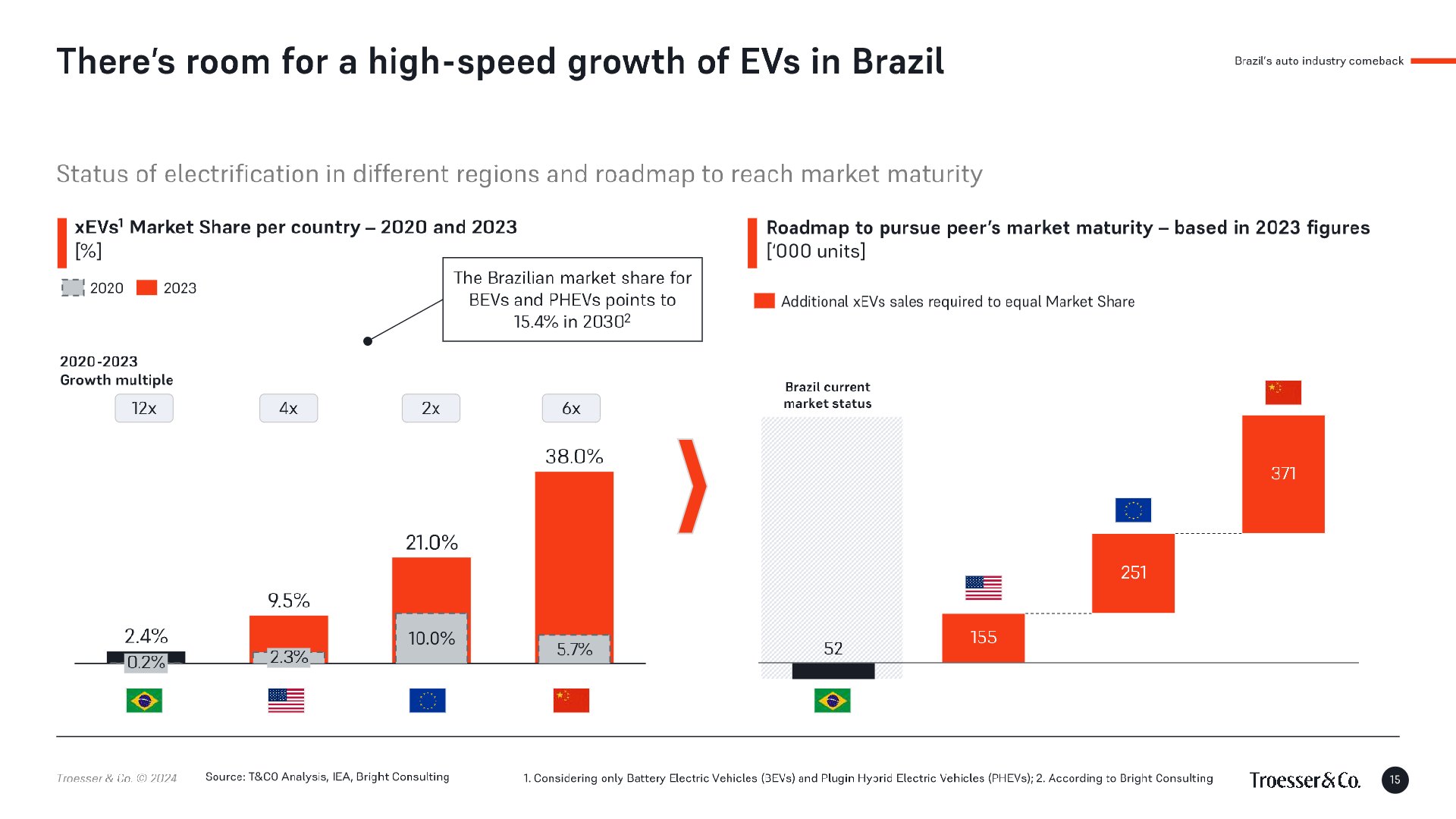
Worldwide, battery-electric and plug-in hybrid vehicles reached 18% of sales in 2023, and China’s share of the global EV market rose from less than 10% in 2013 to more than 50%. Brazil’s auto industry is at an earlier stage. Its xEV market share grew twelvefold between 2020 and 2023, from 0.2% to 2.4%, compared with 9.5% in the United States, 21% in the European Union and 38% in China. Forecasts point to a 15.4% share for BEVs and PHEVs in Brazil by 2030. Based on 2023 figures, Brazil sold around 52,000 xEVs. Matching the US market share would take roughly 155,000 additional units a year, and matching China’s about 371,000.
What this means for Brazil’s auto industry
Brazil’s auto industry is growing again, but the best opportunities are not where they were in the past, and the competitors are different. Our analysis points to a distinct set of questions for each part of the value chain.
OEMs. Segments are becoming niched and overlapping, and Chinese OEMs enter with distinctive positioning and a different footprint and supply-chain setup. Established manufacturers will need better market intelligence, a review of product business cases and portfolios, a clear assessment of their cost position, and partnerships across product, technology, footprint, supply, distribution and finance.
Suppliers. More vehicles and platforms mean more volatile project volumes. Flexible production lines and contracts, an understanding of how Chinese OEMs do business, commercial excellence under the margin pressure established OEMs will pass on, and plans to attract and retain skilled labor all gain importance. US nearshoring under USMCA also opens room for an export strategy toward North America.
Dealers. Brand portfolios, product ranges and customer loyalty are all shifting. Dealer groups will need to review their strategies by segment, brand and geography, adapt to hybrid and battery-electric ranges, align inventory with what customers actually demand, and consider other Latin American markets.
For all three, planning uncertainty remains high, driven by shifting market shares, Argentina’s possible recovery, rising costs and Brazil’s fiscal situation. Scenario planning, with a clear risk assessment and mitigation plans, is the common requirement.
Read the full report
The full white paper on Brazil’s auto industry, with the complete data and analysis, is available below. It was written by Rodrigo Custodio, Senior Partner at Troesser & Co., with Mateus Bellato and André Henrich.
Download the full report (PDF)